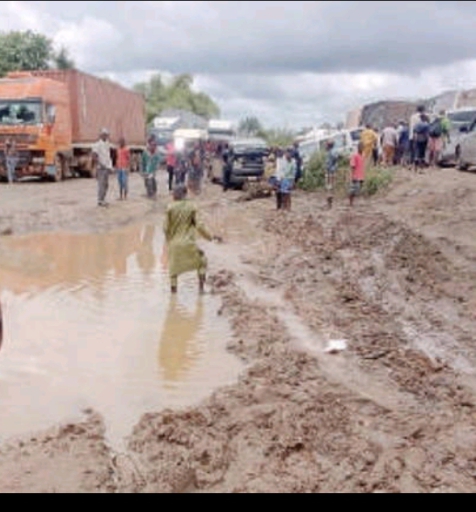
Despite ongoing rehabilitation works, road users say the efforts are moving too slowly to address the worsening conditions. The road, which has shown signs of severe wear and failure since 2018, is said to have deteriorated due to poor drainage design and lack of maintenance.
A section of the road, stretching from the by-pass area near Benin to the Ologbo-Koko junction, has become particularly difficult for vehicles. Although the Edo State Government has taken over the rehabilitation of some portions previously handled by Levant Construction Company, completing about 5.5 kilometers of stone-based and reinforced concrete pavement. Yet the larger section remains in a poor state.
The condition of the road was further worsened at a point by political disagreements between the state and federal governments, with each blaming the other for inaction. While the road falls under the purview of the federal government, residents believe the state could have done more to apply temporary measures.
A resident of Ogheghe near the by-pass, Igbinovia Lucky, said since moving into his apartment in 2022, daily commuting has become a struggle.
“Since I parked into my apartment in 2022, it has been a nightmare coming to the city and going back home at close of work,” he said.
He explained that journeys that should ordinarily take between 30 to 45 minutes now often last five to six hours, especially in the evenings.
“Most times, a journey which ordinarily should take an average of 30 – 45 minutes, last up to 5 or 6 hours just from my place of work at the government secretariat to where I live in Ogheghe and same applies to other persons who live along that route or do business on that axis,” he said.
Transporters who operate along the Benin-Warri route say the road’s condition is affectingtheir operations. Sunday Ochuko, a commercial driver, said the bad sections of the road have reduced the number of trips they can make daily.
“The bad state of the road has increased accident risks occasioned by trucks that often get stuck, tip over, or delay for days,” he said. “The end result is incidents of theft, livestock being abandoned or offloaded from trucks, and security concerns including kidnappings along certain stretches.”
Ochuko added that vehicles experience more damage and require frequent repairs, while fuel consumption has also increased due to longer travel times and diversions.
A fruit vendor who buys produce in Benin and sells in Sapele said she regularly incurs losses due to delays and spoilage.
“Apart from that, businesses, individuals, and lost hours. What might be a 1‑hour trip becomes 5‑6 hours. This reduces the number of trips, lowers work hours, increases delays in supply chains.”
Ochuko noted that the Benin-Sapele road is an important link between Edo and Delta states and plays a major role in the movement of goods and services.
“The corridor is vital for trade between Edo and Delta states (and beyond) but poor road quality makes it harder to move goods efficiently to market, possibly reducing competitiveness,” he added.
Farmers, too, are affected. Many struggle to transport their produce on time, resulting in damage or spoilage before reaching the market, which in turn reduces income and affects food supply.
“Fares for passengers have nearly doubled on the Benin to Sapele route.”
Another business owner at Ologbo , who does not want her name in print said.
“Transport operators are making fewer trips per day. Business owners suffer low patronage because the road takes too much time or because vehicles break down. Goods are being damaged,” he added, pointing out that trucks can no longer access his location for distribution.
With the rains increasing travel difficulty and the repairs moving slowly, many say they can only hope that the government will speed up efforts to fix the vital route before the damage to the economy and daily life becomes irreversible.