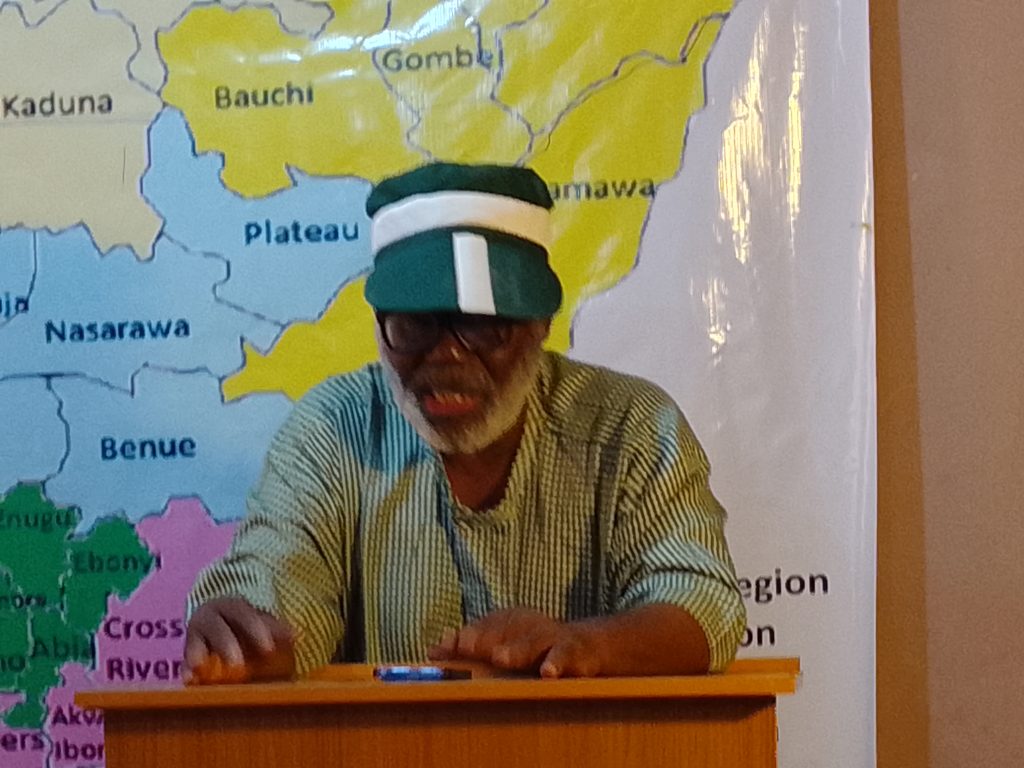
The President of the Benin-based God and People Prayer Parliament, Dr. Dele Oluwatade, on Thursday called for the creation of seven confederation republics in Nigeria as a lasting solution to the country’s political instability.
Speaking to journalists in Benin City as part of his reflection on the significance of June 12, Nigeria’s Democracy Day, Dr. Oluwatade stated that the current structure of the country can no longer support peace, unity, or progress. He advocated the formation of republics that reflect the ethnic and regional realities of the country.
These include the Hausa Republic of Nigeria, Borno Republic of Nigeria, Middle Belt Republic of Nigeria, Midwest Republic of Nigeria, Niger Delta Republic of Nigeria, Yoruba Republic of Nigeria, and Biafra Republic of Nigeria.
Dr. Oluwatade argued that the creation of these republics would mark the beginning of the fight against what he described as the “Fulanization” of Nigeria. According to him, the Fulani have, in his view, ceased to stand in brotherhood with other ethnic groups in the country.
“Technically, Fulani is no longer standing in brotherhood with us. So technically, they are not members of the Nigerian community. At best, the best word to describe them is that they are an invading army—both the Bororo, the newcomers, the terrorists invited—all of them are the same stock. Those of them living with you are the detectives and the ground forces that report you to their active politicians and terrorists,” he said.
He further described Nigeria’s current state as one facing “the ultimate conspiracy,” alleging that the Fulani nation is at war with the rest of the Nigerian nation. Dr. Oluwatade emphasized the need for a decentralized military and security system to enable the proposed republics to maintain their own order.
“If they can’t fight as Nigerians, they should be able to fight as Yoruba, or Ibo, or Middle Belt soldiers,” he stated.
Dr. Oluwatade also called for the immediate demobilization of all Fulani officers in the Nigerian Army, along with repentant Boko Haram members who have been reintegrated into the military. He questioned their loyalty and accused them of leaking sensitive military intelligence, which, according to him, has resulted in numerous ambushes and mysterious deaths of Nigerian soldiers fighting insurgents.
“For security reasons, all Fulani officers in the Nigerian Army, all repentant Boko Haram that had been absolved in the Nigerian Army should be demobilized because it is not possible for them to be loyal orregarded as loyal or to be entrusted with sensitive information and battle tactics and strategies—it will always leak. And that is why we have what we can call ambush, successful ambushes, and deaths of heroes of Boko Haram wars being killed in strange ways,” he said.
Dr. Oluwatade was also critical of Democracy Day, describing it as a product of a political history plagued by repeated conspiracies. He said that from independence, Nigeria has been engulfed in a series of betrayals and internal plots.
“Right from independence, there had been conspiracies. The independence opened with conspiracy against the West, followed by conspiracy against the East. After the Federal Government declined the Aburi Accord, then there was bloodletting, counter-accusations, counter-coup of conspiracy, then the war, and so on. It has been politics of conspiracy,” he said.
He dismissed both the parliamentary and presidential systems as unsuitable for Nigeria’s needs, noting that the former led to the 1960s’ political crisis known as “Operation Wetie,” while the latter has become too centralized to effectively respond to the country’s diverse challenges.
“Last time you came, I was talking of regional parliamentary system government. I have advanced and gone beyond that. Regional parliamentary system cannot help Nigeria today because it was the first parliamentary system that gave birth to the first conspiracy problem that led to Operation Wetie. That led to the war. Presidential system has failed because it is too central to be relevant to the local variable needs of the people. Thank God that our security system officers, they were very honest and unpretending. They say that they cannot cope with the security problem of Nigeria again because they are being overwhelmed, and the reason for their being overwhelmed is not too far-fetched,” he stated.
He urged the Yoruba and Igbo ethnic groups to work together as a united force to protect the future of Nigeria’s black nations.
“After you have achieved that, then you can do anything you like to each other if you are foolish. Channel your separatist energies together for all black nations,” he added.
Dr. Oluwatade identified three politically disadvantaged groups in Nigeria: West Muslims, Middle Belt Christians, and the Hausa nation. He maintained that the creation of autonomous republics is the only path to justice and equity for these groups.
He concluded by calling on traditional rulers and ethnic groups across the country to establish joint security frameworks.