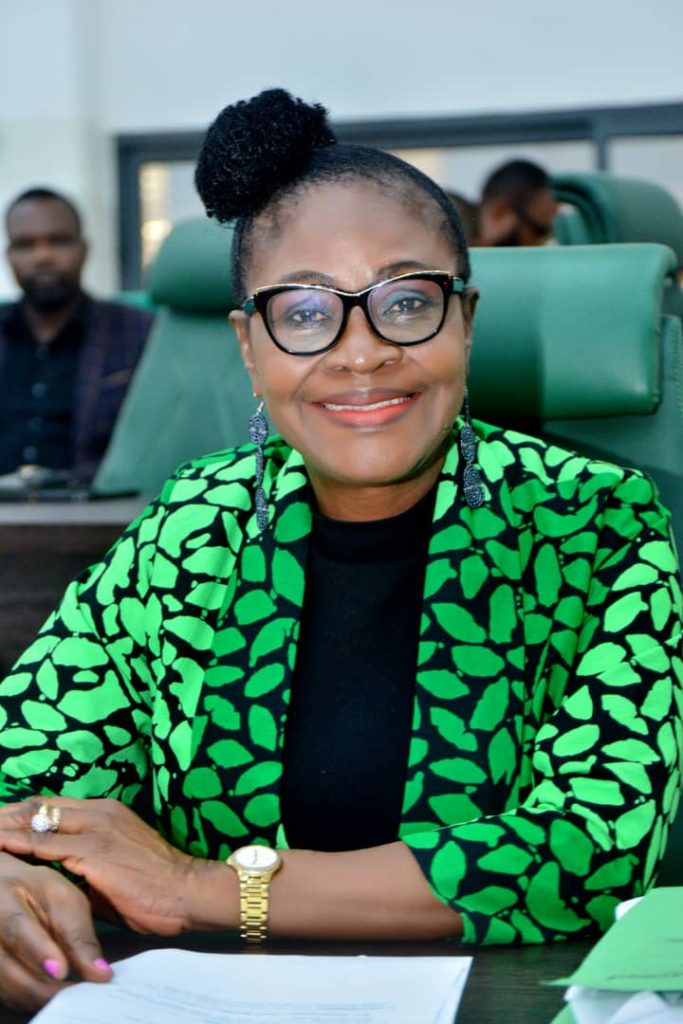
Former Deputy Speaker of the Edo State House of Assembly, Rt. Hon. Maria Omozele Oligbi-Edeko, has made a passionate call for collective support from stakeholders to ensure the passage of the
Nigeria Reserved Seat Bill for Women.
She stressed the importance of increasing female participation in governance and addressing the long-standing imbalance in political representation.
Speaking as a panelist at the Nigerian Bar Association’s 2025 Annual Law Week, held at the High Court Complex in Benin City, Oligbi-Edeko, who currently represents Esan North East Constituency II in the Edo State House of Assembly, decried the alarmingly low representation of women in Nigeria’s legislative arm. She attributed this gap largely to entrenched cultural barriers that hinder women’s political advancement.
“Nigeria currently has only 3.6% female representation in parliament,” she noted. “This is grossly inadequate when compared to other African nations like Rwanda, Namibia, and Senegal, which boast of 61.3%, 46.2%, and 44.2% respectively.”
The lawmaker urged her colleagues in the National and State Assemblies to throw their weight behind House Bill No. 1349, which is currently under review in the constitutional amendment process. The bill seeks to create reserved seats specifically for women in the federal and state legislative bodies.
Outlining the contents of the bill, Oligbi-Edeko explained that it proposes the creation of 37 additional seats for women in the Senate, another 37 in the House of Representatives, and 108 seats across the State Houses of Assembly. In total, 182 seats would be exclusively contested by female candidates, with the intent of marginally boosting female representation without barring them from contesting regular seats.
“These seats are not superior or inferior to the existing ones,” she clarified. “Every political party will nominate a female candidate to run for these seats. These women will campaign and earn their mandate through the votes of the people.”
She highlighted that the cost implications are minimal, estimating the budget increase at less than 1% for the national legislature and about 0.22% at the state level.
However, she warned that the long-term cost of excluding women from governance could be as high as 95%, citing the lost potential in productivity, lawmaking, and inclusive leadership.
“Society can benefit from a wider talent pool, increased productivity, economic growth, laws that protect vulnerable persons, foster a harmonioussociety where everyone is valued, better governance, and a more prosperous, equitable, and peaceful future for all,” she emphasized.
Oligbi-Edeko called on political, religious, and traditional leaders to rise above partisan or cultural sentiments and join efforts to persuade lawmakers to pass the bill. She urged collaboration with civil society organizations and advocacy groups to push for the bill’s enactment.
She expressed optimism that with widespread support, the bill — which has already passed its second reading in the House of Representatives — would eventually become law. “It is not a woman thing; it is for our collective good,” she declared.
Encouraging women professionals to become more politically active, Oligbi-Edeko stressed the need for their participation in political parties and electoral processes. She encouraged women from all professions, including academia, to join political discourse and contest elections.
“There is room for professional women,” she stated. “If you don’t come out to be part of governance, no one will come to your husband’s kitchen to pick you up.”
She also pointed out the lack of participation by many married women in local governance—either in their communities of origin or their husband’s constituency—leading to further exclusion from decision-making spaces.
“We do not struggle for power with unequal,” she added. “Historically, women have been marginalized in politics, so we are not on the same pedestrian with the men. It is a patriarchy system and a male-dominated world.”
The event also featured a related lecture titled “Equality, Diversity and Inclusive Representation: Converging Roles for Effective Nation-Building”, delivered on behalf of Professor Yinka Omorogbe by Professor Oyinkansola Okunsanya. The lecture described Nigeria’s female representation in politics as “alarming and condemnable,” especially when compared with countries like Rwanda and Serbia, where women account for over 60% of parliamentarians.
Professor Okunsanya urged professional bodies such as the Nigerian Bar Association and the International Federation of Women Lawyers (FIDA) to advocate for the enforcement of constitutional provisions guaranteeing women’s representation.
Earlier in the event, the Chief Judge of Edo State, Justice Andrew Okungbowa, in his welcome address, congratulated the Benin branch of the NBA, also known as the Benin Lion Bar, for hosting a successful Law Week. He called on legal professionals to continue upholding the rule of law to maintain the branch’s status as one of the most respected in the country.