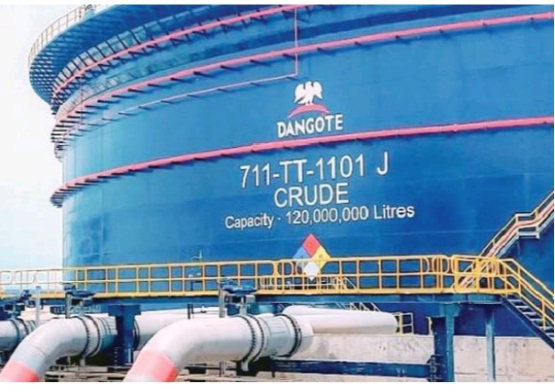
The management of Dangote Petroleum Refinery and Petrochemicals has layed-off a larger chunk of it’s workforce,citing repeated sabotage within the 650,000 barrels-per-day facility.
The company has moved to deny the claims. In an internal memo dated September 24, 2025, and signed by the Chief General Manager, Human Asset Management, Femi Adekunle, the company only announced the termination of services for an unspecified number of employees, directing them to hand over company property and await clearance for their entitlements.
“In view of the many recent cases of reported sabotage in different units of the Petroleum Refinery leading to major safety concerns, the Management is constrained to carry out a total re-organisation of the plant,” the letter read.
“As a consequence of this development, we wish to inform you that your services are no longer required, with effect from the eve of Thursday, the 25th September, 2025.”
The letter, which was addressed to all staff of Dangote Petroleum Refinery & Petrochemicals FZE and Dangote Industries Free Zone Development Company, instructed affected employees to surrender company property and wait for further communication regarding exit clearance. It also directed the Finance Department to compute the entitlements of affected employees in line with their terms of employment.
“We seize this opportunity to thank you for your services while you were in our employment,” the letter concluded.
While the communication appeared to confirm a sweeping disengagement, a senior official of the refinery insisted on Friday that the situation had been misinterpreted, maintaining that it was not a mass sack but a reorganisation aimed at curbing acts of internal sabotage.
“Yes, the letter is correct. But the interpretation is wrong. The interpretation is that it affects some people because of certain things discovered in the refinery. It has nothing to do with unionism or anything like that,” the official stated.
He said the company’s move was designed to “plug leakages and protect the company’s assets” following “repeated acts of sabotage.”
“It doesn’t mean theyhave been sacked. That is incorrect. What was done was to put a check in place. It is more like a clean-up in the system to check where those sabotage and leakages are coming from and then address them. As soon as the issues are addressed, they will be reabsorbed. That is why it is not a sack and that word wasn’t used,” he explained.
He added that the company acted swiftly and without prior notice in order to prevent those involved from concealing or covering up their actions.
“Some acts of sabotage have been noticed repeatedly and the company is only trying to safeguard its assets. Also, you cannot do things like this and give two weeks’ notice; otherwise, those in the act would cover up and complicate issues,” he said.
According to the official, refinery operations are ongoing, and both Nigerian and expatriate staff are still working at the plant.
“As we speak, people are still working at the refinery. The people affected know themselves, and those who did not get the letter are not affected. Anyone who doesn’t have a hand in sabotage has nothing to worry about,” he said.
Efforts to reach the company’s spokesperson, Anthony Chiejina, for an official statement proved unsuccessful, as messages sent to him were not responded to as of press time.
The refinery, which began production in 2024 with high hopes of reducing Nigeria’s dependency on imported petroleum products, is facing mounting operational and labour challenges.
Recently, the Nigeria Union of Petroleum and Natural Gas Workers (NUPENG) accused the company of “high-handedness” and raised concerns over labour practices and safety conditions. The union warned against what it described as an emerging pattern of unfair treatment of workers.
In addition, Dangote Refinery has clashed with the Depot and Petroleum Products Marketers Association of Nigeria (DAPPMA) over product pricing and distribution. Marketers have accused the refinery of imposing restrictive conditions that could disrupt the downstream oil market.