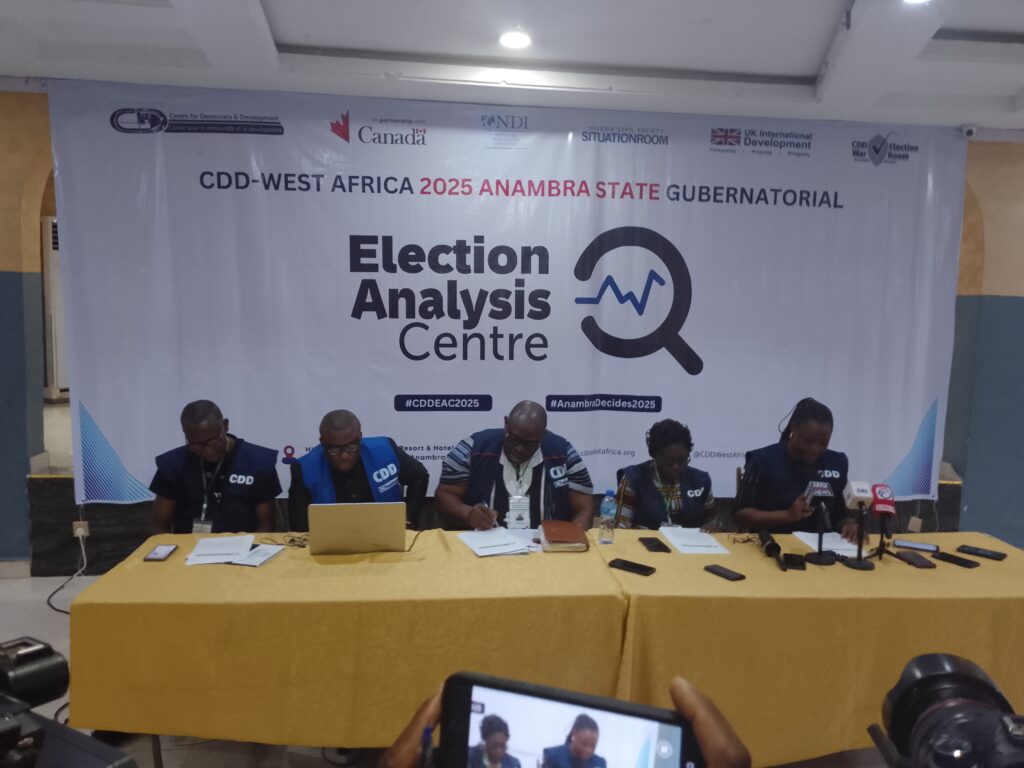

The Centre for Democracy and Development (CDD-West Africa) has raised concerns over low electoral competitiveness, growing voter apathy, and the fragility of key institutions ahead of the November 8, 2025, Anambra State Governorship Election.
Speaking at the opening of its Election Analysis Centre (CDD-EAC) in Awka, the organisation described the upcoming poll—the first off-cycle governorship election under the new INEC leadership of Professor Joash Amupitan—as a crucial test of Nigeria’s democratic resilience and institutional credibility.
According to the CDD, “This is another opportunity for the two million, eight hundred and two thousand, seven hundred and ninety (2,802,790) registered voters in the state to make their voices heard in electing the next state governor.” Despite INEC’s report of a 98.8 percent Permanent Voter Card (PVC) collection rate, the group expressed concern that this might not translate into high voter turnout.
The Centre announced the release of two reports titled “Anambra 2025: A Barometer of Party Fortunes, Federal Might and Personalities” and “Evaluating Disinformation Risks Ahead of the 2025 Governorship Election in Anambra State.” Both reports, it said, underscore the importance of the election as a decisive test for Nigeria’s democracy.
CDD-West Africa revealed that it had deployed 178 trained and accredited observers across all 21 local government areas, focusing on polling units with high volumes and prior histories of electoral challenges. Additionally, 57 grassroots monitors known as “Soldiers of Mouth” have been positioned to counter misinformation, corroborate fact-checks, and monitor disinformation trends. The Centre also deployed 30 mandate protection observers to detect and report any electoral irregularities.
On institutional preparedness, CDD noted that while INEC has taken commendable steps to improve logistics and planning, “confidence remains fragile.” It pointed out that the Continuous Voter Registration (CVR) process exposed logistical gaps that require urgent attention. The organisation also called attention to the judiciary’s role, warning that “delayed rulings and uncertainty over candidate eligibility continue to damage public trust.”
The statement criticised the inability of political parties to mobilise and sensitise voters, saying that internal crises within major parties have weakened electoral competitiveness in the state.
Security concerns were also highlighted, particularly in Ihiala, Nnewi South, Orumba South, and border communities such as Lilu, Azia, and Amorka. CDD warned that weak oversight of vigilante groups and a history of violence could lead to low voter turnout, urging security agencies to “act professionally and protect voters without bias.”
On incumbency and federal influence, the organisation observed
that the ruling All Progressives Grand Alliance (APGA) and the incumbent governor benefit from visibility advantages, new political alignments, and control over state influence channels. It referenced the Anambra State Signage and Advertisement Agency’s (ANSAA) June 11, 2025 announcement imposing a N50 million permit fee for political parties’ billboard and outdoor campaigns, saying the policy “limits access for different political parties and increases campaign costs,” despite the N1 billion campaign spending cap under Section 88(2) of the 2022 Electoral Act.CDD-West Africa also raised alarm over the state’s information environment, identifying widespread misinformation, disinformation, and hate speech as major threats to the election’s integrity. The organisation’s assessment found “unequal access to information, gender-specific vulnerabilities, inadequate stakeholder preparedness, and persistent electoral risks.”
Seven dominant patterns of information manipulation were identified: targeting of security institutions with partisan bias claims, exploitation of religious divides, manipulation of political endorsement narratives, weaponisation of insecurity and “unknown gunmen” narratives, distortion of Igbo campaign statements, narratives questioning INEC’s competence, and gendered hate speech aimed at discouraging women’s participation.
In response, CDD said it had launched several interventions, including capacity-building sessions for stakeholders on countering information disorder and engaging local content creators to combat misinformation on social media.
The group lamented continued exclusion of women, youth, and persons with disabilities (PWDs) from the political space, noting that “only two women are contesting, both from minor parties,” while there are “no PWD candidates” and polling accessibility remains poor.
CDD-West Africa called on INEC “to maintain neutrality and ensure seamless electoral processes, such as the timely deployment of voting materials and smooth functioning of BVAS/IReV.” It urged security agencies to protect citizens “without intimidation or selective enforcement,” and appealed to political parties to “shun vote buying and commit to peaceful conduct.”
It further called on civil society and the media to amplify factual information and promote inclusive participation, while encouraging citizens to come out and exercise their democratic right to vote.
“With the CDD Election Analysis Centre (EAC) now fully operational, our disinformation experts will be working throughout the period to monitor, fact-check, and respond to emerging narratives,” the organisation said. Citizens were also urged to report suspicious content to its WhatsApp helpline at +234 704 150 2298.
“The 2025 Anambra Governorship election is more than a sub-national election,” CDD-West Africa declared. “We call on all actors to prioritise national interest, protect democratic integrity, and ensure a peaceful, credible and inclusive election.”