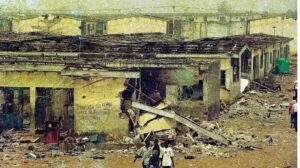
Sunday, January 27, 2002, remains one of the nights that many Lagos residents will never forget.
It was a night when the city was suddenly thrown into confusion, fear and panic following a massive explosion at the ammunition depot inside the Ikeja Military Cantonment.
For many people, the sound began like distant thunder.
But it was not thunder.
Lagos was shaking.
I was at Abule-Egba that fateful evening with some friends who had come to visit me.
Suddenly, we started hearing sounds that resembled a severe thunderstorm. But something was different. The building itself was vibrating.
We became increasingly worried.
A neighbour immediately put on the radio. It was RayPower FM.
Then we heard the announcement:
“If you are in a tall building, please come down. We don’t yet know what is happening.”
Those words immediately heightened the fear.
We had no idea what was happening or where the sounds were coming from.
When we eventually got outside, we saw people running towards Agbado-Jaiye.
Everyone appeared frightened, but nobody seemed to have a clear explanation.
People were asking one another:
“What is happening?”
There were different answers and rumours.
Some people were saying that Osama bin Laden had bombed Murtala Muhammed International Airport.
At that moment, without today’s social media and instant access to information, rumours could travel rapidly, especially when people were already terrified by the sound of explosions.
My friends eventually left for Agbeda area, while the confusion continued.
Only later did we begin to understand the terrible reality.
The Ikeja Armoury Explosion
A fire at the ammunition depot inside the Ikeja Military Cantonment had triggered a series of massive explosions.
Artillery shells, bombs and other ammunition were propelled into surrounding areas as the explosions continued for hours.
The impact was felt several kilometres away.
Homes and buildings were damaged, windows shattered and thousands of residents fled in fear.
But tragically, the greatest loss of life was not caused directly by the explosions.
It happened as people desperately tried to escape.
The deadly flight to safety
Thousands of residents ran through the darkness, believing they were escaping a war zone.
Many headed towards the Oke-Afa canal, unaware that what appeared to be a safe path was actually deep
water covered by thick water hyacinth.People fell into the canal.
Children, women and entire families were among those who drowned.
Rescue workers spent days recovering victims from the water.
By January 30, official figures had reached about 700 deaths, while subsequent reports placed the overall death toll at more than 1,000. Many others were injured, missing or left homeless.
Behind those numbers were real families and real lives.
A night that changed countless families.
President Olusegun Obasanjo visited the devastated cantonment the following day and ordered an investigation.
The tragedy also raised serious questions about the condition and location of the military ammunition depot and its proximity to densely populated communities.
The government subsequently announced plans to relocate ammunition storage facilities away from densely populated areas.
But for the families who lost loved ones, nothing could truly undo the tragedy.
Some people never found their loved ones.
Some children lost their parents.
Some parents returned home without their children.
And some families disappeared together.
More than an explosion.
For those who experienced that night, January 27, 2002, was not simply a historical event.
It was a night when ordinary life suddenly turned into uncertainty.
For me, the memory remains vivid: the strange sounds that first seemed like thunder, the vibrating building, the RayPower broadcast asking people in tall buildings to come down, and the sight of frightened people running towards Agbado-Jaiye without knowing exactly what had happened.
It is a reminder of how quickly fear can spread when people do not have accurate information during a crisis.
More than two decades later, the victims deserve to be remembered beyond statistics.
January 27, 2002.
The night Lagos shook.
The night families were changed forever.
May the souls of all those who lost their lives rest in peace.
DO YOU REMEMBER THAT NIGHT?
If you were old enough to remember the Ikeja Armoury explosion, what is the first thing you remember hearing, seeing or experiencing?
Share your memories with us. Your story may help preserve an important part of Lagos and Nigeria’s history.
#IkejaArmouryBlast #IkejaBombBlast #LagosHistory #NigeriaHistory #Remembering2002 #NeverForget #Lagos #Ikeja #AbuleEgba #AgbadoJaiye #Agbeda #OkeAfa #NigerianHistory #LagosMemories #HistoryMustNotForget #Wawareporters #Heart2HeartWithSammy #SammyTheAfricanArchivist