


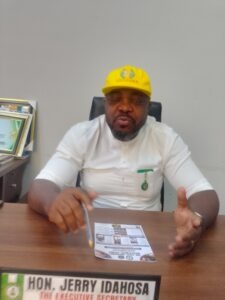
Hon. Jerry Idahosa is the Executive Secretary of the Edo State Emergency Management Agency (EDOSEMA). In this interview with Francis Ogbuagu in Benin City , he speaks on the measures by the agency to checkmate the effects of flooding as predicted by the Nigerian Meteorological Agency (NiMet).
Excerpt:
Q: You have reconstituted the Local Emergency Management Committees in the 18 Local Government Areas. What do you expect from the Committees ?
A: The purpose of reconstituting the Local Emergency Management Committees (LEMCs) in the 18 local government areas is because they are closer to the grassroots and the communities. Just as we have the State Emergency Management Committee (SEMC) and the National Emergency Management Agency (NEMA) at the federal level, each local government committee is expected to drive emergency response across the 18 local government areas.
Their responsibilities include responding to flooding, fire outbreaks, bridge collapses, building collapses, and every other form of disaster. One of the major objectives of setting up these committees is to sensitize communities on what they need to do, where they should go in the event of flooding, and the emergency numbers they should call for assistance. They are also expected to educate residents on safety practices, preventive measures, and what to do whenever they are faced with disasters in their communities. That is the major objective of the LEMCs.
Q: The state is prone to flooding, especially in Edo North, where some people have died and property has been destroyed. What is the state doing to ameliorate the condition of the victims?
A: When you say some persons have died, I want you to be exact. The only report we received was of a man who was swept away by flood in Igarra, Akoko-Edo Local Government Area. Aside from that, there was another case involving a man, about 50 years old, who was swept away by flood in Uhunmwonde Local Government Area. I think these are the only two cases that have resulted in fatalities so far.
You asked what the state is doing to alleviate the suffering of the victims. The committee in Akoko-Edo sent us a detailed report on the affected flood victims. We also received reports from parts of Etsako Central Local Government Area, where some farms were affected by flooding.
We have carefully verified the names of the victims to ensure they are genuine because we have seen cases where names were included even though those people did not suffer any losses. We have vetted the list and are waiting for His Excellency, the Governor of Edo State, Senator Monday Okpebholo, to approve it. We are confident he will give the approval.
Before then, we contacted NEMA because flooding is a national disaster. As a state, there is a limit to what we can handle. When the situation is beyond our capacity, we seek intervention from NEMA. For now, we have captured the victims, and we are waiting for the governor’s approval to proceed. Help is on the way for the victims.
Q: Flooding in Edo goes beyond the two local government areas you mentioned because of people’s habit of dumping refuse in drainage channels. If you visit many densely populated areas, you will discover that the drains are blocked with waste. What is your agency doing to educate people and encourage a safer environment?
A: Thank you for that question. Part of what we are doing is carrying out assessments in these areas. Blocked drainage channels are not the only problem. We have also discovered that people have built houses on moats and waterways that were originally mapped out to control erosion.
We have seen communities sell these government-owned moats and waterways to individuals, who then develop and build houses on them. We are working with the Edo State Ministry of Physical Planning, the Ministry of Environment, and relevant agencies to identify those government-owned moats and waterways where buildings have been erected. These structures will be marked and demolished , so that the state government can reclaim the land and channel floodwater away from our cities
As for clearing blocked drainages, that is not our direct responsibility. However, we are working closely with the Ministry of Environment and the Edo State Waste Management Board. The board has carried out extensive sensitization campaigns, encouraging residents to procure waste bins and providing contact numbers for waste managers who can be assigned to them.
Unfortunately, many people still dump refuse indiscriminately because they do not want to pay for waste disposal services. They wait until it starts raining before bringing out their waste and dumping it on the roads. As a result, the government spends enormous amounts every month clearing blocked drainages.
We are using this opportunity to appeal to residents because disaster management is everyone’s responsibility. You cannot say it is not your concern because when flooding occurs, it will affect your home as well. Our responsibility is to identify these vulnerable areas, notify the appropriate agencies to clear them, and then monitor and evaluate the work to ensure it has been properly done.
Some gullies started as small channels but have now become major environmental hazards.
Q: What is your agency doing regarding people living in flood-prone areas, particularly with respect to relocating them to safer locations?
A: We started preparations even before the rains began. We sent messages to all the local government chairmen, particularly those with government-owned Internally Displaced Persons (IDP) camps, directing them to inspect the camps and ensure they were in good condition for possible occupancy. This was done around February and March, months before the rainy season started.
That was also one of the reasons for our stakeholders’ meeting held on July 22, 2026, where some local government chairmen attended while others sent representatives or Heads of Social Services (HSS). During the meeting, we reiterated the need for them to engage communities and educate residents on why they should temporarily relocate to higher ground.
In places where there are no IDP camps, they have been advised to make use of Primary Healthcare Centres, Skill Acquisition Centres, and primary schools as temporary shelters. We have also made plans to provide temporary tents if the number of displaced persons increases.
As we speak, all local government chairmen are on red alert. Should any community require evacuation, they must notify us because they may not have the capacity to handle it alone. We will then invite NEMA, the Federal Road Safety Corps (FRSC), and both the Federal and State Fire Services to assist with the evacuation.
At the moment, we have not received any emergency reports because the river level is not yet high. Once we receive a red alert that the river is rising, we will commence the evacuation of people living in the coastal communities along the River Niger basin.
Q: What are the major challenges your agency has faced?
A: One of the greatest challenges we face is that many people insist on remaining in their ancestral homes. They often reject evacuation because they believe it is their ancestral land.
We are not asking them to leave permanently. We only want them to relocate temporarily for their safety. Once the floodwaters recede, they can return to their homes.
When people refuse to be evacuated, we engage their traditional rulers to speak with them because they are more likely to listen to their own leaders. This remains one of our biggest challenges.
We also want the media, non-governmental organizations (NGOs), and other stakeholders to assist us , because sensitization, early warning, and public awareness are critical. There are also operational gaps, particularly when some agencies fail to provide timely information. However, these issues were discussed extensively during the stakeholders’ meeting held last Friday.
Q: What is the level of collaboration between your agency and the Edo State Ministry of Health in the event of an outbreak of waterborne diseases?
A: As I said earlier, that was one of the reasons we convened the stakeholders’ engagement meeting. Following that engagement, I can confidently say that our collaboration with the Edo State Ministry of Health is now top-notch, and I assure you that we will continue to work closely together.