By OnyedikaChukwu George Nnaedozie
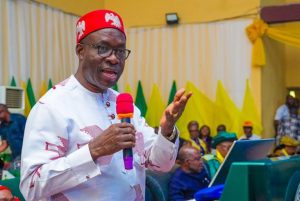
There is a particular kind of wound that only a familiar hand can inflict. When Professor Charles Soludo stood before a crowd and declared that the Southeast contributes only 8% to Nigeria’s GDP, and that if the entire region collapsed tomorrow Nigeria would treat it as a human disaster and simply move on, he did not just misread an economy. He handed the federal establishment the exact language it has always needed to justify fifty years of deliberate exclusion, and he handed it to them wearing the face of an Igbo governor.
If he stopped at the 8% figure, it would have been a case of numbers but he went further to show how a man can be so selfish to the point of sacrificing regional interest for selfish ambition that he’ll never achieve.
He claims that the disappearance of tens of millions of people, their markets, their industries, their apprentices, their traders spread across every commercial hub in this country, would register as nothing more than a humanitarian footnote before Nigeria moved on with its life. That is not an economic assessment but a statement about how little a people matter and it came from a man who governs a very important state in the South East. His counterpart in Imo State, who sits inside the ruling APC and has the ear of the Federal Government, will never stoop this low. This is coming just within the period the people of South East are marking an anniversary to remember those who were brutally killed in the Biafran war.
Now let us deal with the numbers, because the numbers do not support him.
BudgIT’s 2022 subnational GDP data, the most widely referenced breakdown available, puts the Southeast’s output at approximately 20 trillion naira. South East is the smallest region in Nigeria with some of the smallest states both in landmass and in creation. South East was deliberately made to be small for political reasons.
The North-West, a zone with more states, more land, and far more federal allocation flowing into it, sits at roughly 20.37 trillion. When you place the Southeast figure against Nigeria’s total nominal GDP for that period, you arrive at a contribution between 11 and 13 percent, not 8. Imo State alone was generating 7.68 trillion naira. Anambra, Soludo’s own state, was at 5.14 trillion. These are not the numbers of a zone that Nigeria could absorb losing without consequence. These are the numbers of a region that has been deliberately starved of infrastructure, oil revenue access, and federal presence, and has still managed to outpace or match zones that received significantly more from the center.
And even that 11 to 13 percent is an undercount, because of how Nigeria measures economic activity.
The National Bureau of Statistics captures what it can see, formal transactions, oil receipts, registered businesses, large urban service activity. It cannot fully see Onitsha Main Market, which moves goods at a volume that makes it one of the largest open markets on the African continent. It cannot fully see Aba, where unregistered workshops are producing leather goods and garments that circulate across West Africa without ever appearing in an official ledger.
It cannot fully see Nnewi, where auto parts manufacturers have built an industrial cluster entirely through private capital and cultural discipline, with no government co-investment to speak of. The Southeast’s real economic footprint is considerably larger than any figure derived from formal data sources, and any economist of Soludo’s caliber understands this. Which makes his statement harder, not easier, to excuse.
Then there is the Igba Boyi system, which is not a cultural curiosity but a capital formation engine with no equivalent anywhere else in Nigeria. A young man enters a senior trader’s household, learns the trade across several years of structured mentorship, and is then settled with startup capital to establish his own enterprise.
That business takes on its own apprentices in time and the cycle continues, compounding across generations. No bank loan. No federal grant. No government program. Just a self-sustaining institution that has produced thousands of independent entrepreneurs and seeded Igbo commercial networks from Lagos Island to Nairobi to Houston. You cannot find that in a GDP table,
but you can find its effects in every major market in Nigeria and in a significant portion of Nigerian-owned businesses abroad.The diaspora dimension is equally significant and equally invisible to standard economic measurement. Nigeria receives between 20 and 25 billion dollars in annual remittances, a figure that rivals foreign direct investment and exceeds several federal budget lines. Igbos constitute a disproportionate share of Nigeria’s high-achieving diaspora, and the relationship between those abroad and their home communities is not sentimental. It is economic. Money flows back to build schools, capitalize businesses, and construct roads that the federal government never prioritized. None of that enters the Southeast’s official GDP. All of it shapes what the region is and what it can become.
What makes Soludo’s framing genuinely dangerous is the historical context surrounding it. This is why the most shameful part of all of this is that his statement came within the same period of annual mourning, a mourning that even the Federal Government or Soludo’s own state government has failed to recognize.
After the civil war ended in 1970, Igbos returned to find their properties seized under abandoned property laws, their bank accounts reduced to a flat 20 pounds regardless of what they had deposited, and a federal government that had just defeated them now deciding how much of their own country they would be permitted to reclaim. There was no reconstruction fund for the Southeast. There was no infrastructure drive, no special federal allocation, no formal mechanism for recovery. There was only a people who rebuilt from almost nothing through private enterprise, community coordination, and the same cultural institutions that Soludo’s statement implicitly dismisses. To look at the output of that rebuilding under those conditions and describe it as economically marginal is to misunderstand either the history or the arithmetic, and a former CBN Governor understands both.
Soludo’s framing pretends that the Southeast exists in economic isolation from the rest of Nigeria. Lagos is Nigeria’s commercial capital partly because Igbo entrepreneurs chose to build there. The Alaba International Market, the Ladipo spare parts complex, the Balogun wholesale district, these are not Lagos phenomena operating independently of Igbo enterprise. They are Igbo commercial activity operating within Lagos geography, generating turnover that shows up in Lagos State’s IGR, funding a Lagos tax base that the whole country envies. Remove that enterprise from the national equation and you do not simply lose a region. You remove a commercial nervous system that runs through the entire country’s trade and distribution infrastructure.
Soludo may have intended his statement as a provocation. Perhaps he was trying to shock the Southeast into economic self-organization, into investing in the SEDC or building regional institutions that do not depend on federal goodwill. If that was the intent, the execution was reckless, because the statement as it landed did not provoke. It confirmed what the federal establishment has always said about Igbo expendability, and it confirmed it in the voice of the most prominent Igbo politician currently holding executive office.
A region told that its disappearance would be absorbed as a temporary human inconvenience is not motivated to integrate more deeply with the national project. It is handed one more reason to question whether that project ever included it. This is the same region a sitting President, Buhari, called “dot in a circle” in a disparaging mockery.
The Southeast is not dispensable. Its people built with their hands and their institutions what the Nigerian state refused to build for them, and they did it while navigating insecurity, infrastructure neglect, political alienation, and the long shadow of a war that the official narrative prefers to treat as settled.
The correct response to that record is not a GDP figure designed to minimize it. The correct response is a serious question, what would this region produce if the state ever decided to show up?
And truth is, Igbos don’t even need Soludo to prove anything. One day, Soludo would need the support of South East and we’ll point him to the wall where his sins have been documented. Until then, he should enjoy his short vacation at Awka while it lasts.
#GracefulGeorge