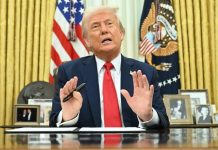
The United States House Subcommittee on Africa on Thursday held a public hearing examining former President Donald Trump’s recent decision to redesignate Nigeria as a Country of Particular Concern (CPC), a classification that heightens U.S. scrutiny over alleged violations of religious freedom.
The session, which began at 5 p.m. in Washington, D.C., was led by Representative Chris Smith and featured senior officials from the U.S. State Department as well as Nigerian religious figures. Members of Congress discussed potential implications of the CPC status, including the prospect of sanctions targeting Nigerian officials and possible limitations on specific categories of U.S. assistance.
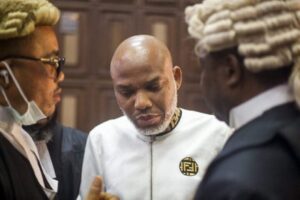
Representative John James, a former chairman of the Africa Subcommittee and now serving on the Energy and Commerce Committee, argued that the redesignation was essential given what he described as a worsening environment for Christians in Nigeria. He said the situation reflects deeper political and institutional breakdowns, citing the prolonged detention of IPOB leader Nnamdi Kanu.
“Nigeria is facing one of the gravest religious freedom crises in the world. I have visited and have seen firsthand the direness of the conditions in what is now the deadliest place on earth to be a Christian,” James said.
He outlined the extent of the violence, adding, “Since 2019, nearly 17,000 Christians have been killed. In the first seven months of this year alone, hundreds more were murdered. These are not isolated tragedies, but a sustained pattern of religiously motivated violence, often ignored or even enabled by the Nigerian government.”
James said extremist organisations including Boko Haram, Fulani militants, and ISIS West Africa continue to launch deadly attacks, often without what he described as adequate intervention from Nigerian authorities. “The lack of response
has created an atmosphere of impunity where Christians continue to live in constant threat and fear,” he noted.Turning to Nnamdi Kanu’s case, James told the committee, “Religious persecution is tied to political repression and weakening institutions in Nigeria. The detention of Mazi Nnamdi Kanu is a clear example. In 2022, Nigeria’s Court of Appeals struck down the charges against him and ordered his release. The UN Working Group for Arbitrary Detention has also called for his unconditional release, yet he remains in solitary confinement in deteriorating health and recently had to represent himself in court.”
He added, “Nigeria has signalled that the law is optional and targeting Christians is fair game. Just hours ago this morning, despite the pleas and cries of Nigerian people and many Nigerian lawmakers, Kanu was convicted on all charges.”
During questioning, Representative James asked whether extremist groups had infiltrated Nigeria’s government. Senior Bureau Official Jonathan Pratt of the State Department’s Bureau of African Affairs responded, “I do not believe that the government of Nigeria has been infiltrated by jihadists.”
James pressed further, referencing what he described as selective enforcement of the rule of law. He then asked how Abuja had reacted since Trump’s announcement of the CPC redesignation. Pratt said Nigerian authorities appeared to be taking the development seriously.
“They have taken the designation very seriously. There is a senior delegation here now. They will meet with the most senior officials of the US government this week, and we have already demarched the government in Abuja and here in Washington on the action plan, and I can say that the results so far have been positive in terms of cooperation,” Pratt said.