Following the November 8 Anambra State governorship election won by Prof. Charles Chukwuma Soludo of the All Progressives Grand Alliance (APGA), the Centre for Democracy and Development (CDD) on Sunday called for better funding of the Independent National Electoral Commission (INEC), and the mandatory, timely uploading of election results through the INEC Results Viewing Portal (IReV).
The organization also recommended measures to combat vote trading, the introduction of early voting for essential workers, and the prosecution of electoral offenders, among others, to deepen democracy in Nigeria.
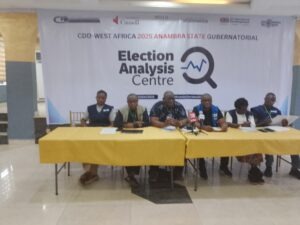
Speaking at a post-election press briefing in Awka, Anambra State, the Chairman of the CDD–West Africa Election Analysis Centre, Professor Victor Adetula, said the organization’s recommendations followed its initial assessment of the 2025 Anambra State Governorship Election.
Adetula stated that while the CDD acknowledged significant progress in the conduct of the polls, it also identified key challenges requiring attention ahead of future elections.
“The Centre for Democracy and Development (CDD) and its Election Analysis Centre (CDD–EAC) have completed their initial assessment of the 2025 Anambra State Governorship Election. While acknowledging significant progress made in the conduct of the polls, CDD also notes key challenges that require attention ahead of future elections,” he said.
According to him, these challenges include ensuring timely funding, decentralized planning, and consistent public communication; improving logistics and personnel training.
Adetula emphasized that for democracy to thrive in Nigeria, there is a need to reform political party practices by enforcing internal democracy and transparent campaign financing, as well as prioritizing voter engagement and issue-based campaigning.
He noted that INEC reported
a 98.8% Permanent Voter Card (PVC) collection rate and achieved a 99.62% result upload on the IReV portal. The election, he said, was generally peaceful, marking a commendable improvement in election administration.However, he observed that 5.4% of polling units experienced delays due to the late arrival of INEC officials. CDD also found that political parties did little to mobilize voters across the state. The campaign period lacked issue-based engagement and was characterized by low visibility — factors that contributed to a less competitive election.
To sustain security beyond elections, Adetula said there is a need to develop a long-term security framework that addresses the root causes of violence, rather than treating elections as isolated security operations.
CDD–West Africa further advocated that the ongoing reforms of the Electoral Act must include stronger enforcement mechanisms.
The organization also called for stronger collaboration among INEC, security agencies, the media, and civil society to fact-check and debunk false narratives quickly, and for improved INEC public communication to provide accurate information promptly.
“CDD tracked over 200 online claims related to the election. Of these, 45 were fact-checkable, with findings showing that 54% were false, 27% were true, 10% were misleading, and the remainder required additional context,” Adetula disclosed.
CDD observers also recorded widespread vote buying across several local government areas, often occurring openly and in the presence of security agents. Voters were reportedly offered between ₦2,000 and ₦10,000, either in cash or through digital transfers.
The group warned that vote buying continues to undermine Nigeria’s elections, becoming a predictable strategy for politicians who fail to engage in issue-based campaigning or deliver quality governance.
–