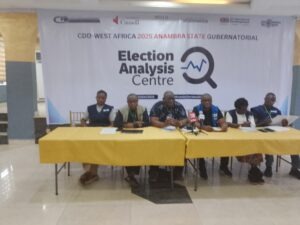
Members of the CDD at the mid-election briefing in Awka
The Centre for Democracy and Development (CDD-West Africa), operating through its Election Analysis Centre (CDD-EAC), has raised serious concerns over widespread voter apathy, irregularities, and the prevalence of vote trading during the 2025 Anambra State Governorship election.
Speaking during the mid-election press briefing, the Executive Director , Dr Dauda Garuba, said the organization had deployed a robust monitoring framework across all 21 Local Government Areas, designed to ensure transparent reporting and real-time analysis of events as they unfold.
He said deployment included 178 trained and accredited observers positioned at strategic polling units, 57 grassroots monitors—popularly known as “Soldiers of Mouth”—tasked with countering information disorder, and 30 mandate protection observers assigned to document and escalate cases of electoral malpractice.
According to him, the observation effort aims to “provide timely, evidence-based insights that promote transparency, restore public confidence, and strengthen the integrity of the electoral process.”
He said, preliminary findings from the field indicated that , “72.2 percent of polling stations opened before 8:30 a.m., while 19.5 percent commenced between 8:30 and 9:00 a.m. A further 1.5 percent opened after 9:00 a.m., with 5.4 percent experiencing serious delays caused by the late arrival of electoral officers and missing logistics.”
He noted that, although the Independent National Electoral Commission (INEC) made strides in early deployment, the delays in several locations highlighted “persistent logistical weaknesses in last-mile delivery, particularly in remote and congested communities, adding that
Instances of such setbacks were recorded in Onitsha North LGA (Ward 15, PU005) and Woliwo Ward 15 (PU001), where voting did not commence until after 9:00 a.m. due to missing security personnel. Similar delays were reported in Ogbaru LGA (Okpoko Ward 5, PU004; Iyiowa Odekpe Ward, PU008) and Anambra East (Ward 002, PU010).
The Centre also confirmed the deployment of the Bimodal Voter Accreditation System (BVAS) across all monitored units. While 78.9 percent of polling stations operated with a single BVAS device, 18 percent had two, and 1.5 percent had more than two. In 96.2 percent of the units, the machines correctly displayed a zero count before accreditation began. However, 3.8 percent failed to show this requirement, contrary to INEC’s operational guidelines.
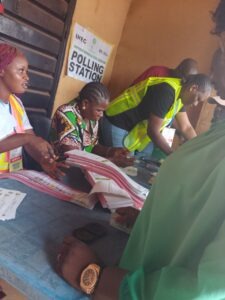
“Technical issues were reported in several locations, including Anaocha LGA, Ward 4 (Agulu), PU011, where the BVAS failed to capture thumbprints without backup support. Similar challenges occurred in Idemili South LGA, Ward 2 (Alor), PU004, and Nkpor Ward 2, Idemili North (PU002), where accreditation had yet to start by late morning. In Njikoka LGA, Umudim Ward 2 (PU035), the facial recognition feature of the device malfunctioned, slowing the process.”
On security deployment, he said CDD observers inconsistent across the state. While 87.3 percent of polling units had officers on site, 12.7 percent recorded no presence
of security personnel as voting began. On average, three to four officers were assigned per unit—most of them male (80.8 percent), with only 19.2 percent female.CDD observed that polling stations linked to prominent political actors received disproportionate security and media attention, leaving smaller or rural polling units vulnerable. In Uga Ward 2, Aguata LGA (PUs 010, 011, and 012), observers reported the complete absence of security officials during the early hours of voting, exposing both voters and officials to potential intimidation and interference.
The Centre warned that “unequal distribution of security resources risks undermining electoral integrity and eroding public trust,” emphasizing that every polling unit deserves adequate and impartial protection.
Again, CDD’s findings revealed rampant vote buying across several LGAs, notably in Anambra Central and Anambra South senatorial zones. In Awka South and Nnewi North LGAs, the organization recorded multiple cases of open inducement in large polling clusters such as Nodu Village Hall 1 (PU009), Nodu Hall 2 (PU010), and Ezinifitte Hall 2 (PU008). Voters were reportedly seen engaging in “vote-and-snap” practices, taking photos of their marked ballots as evidence in exchange for cash.
Reports indicated that political agents distributed between ₦2,000 and ₦10,000 per voter, depending on the area. In PU005, Achina Ward 3, and near PU012, Ward 1, Aguata LGA, observers documented payments ranging from ₦2,000 to ₦5,000. At Ichi PU010 in Ekwusigo LGA and Igboukwu Ward 2, Central School PU017, party agents openly handed out ₦5,000 to voters without any intervention from security personnel.
At Uruagu Ward 1, PU006, Nnewi North LGA, observers reported that party agents kept informal records of voters who received payments—a sign, CDD said, of a “systematic and organized vote-trading mechanism.”
On turnout, he said , despite high youth registration during the Continuous Voter Registration (CVR) period, voter participation among young people was notably low on election day, especially in urban centers such as Awka and Onitsha. CDD attributed this to growing disillusionment, logistical delays, and waning faith in the political process.
Women also faced barriers, both as candidates and voters. Observers reported that some female aspirants were subjected to sexist remarks and dismissive behavior at polling units. “These incidents highlight the enduring cultural and institutional barriers limiting women’s political participation,” the Centre said.
CDD expressed disappointment over the lack of accessibility for persons with disabilities (PWDs), citing multiple polling stations in Onitsha North and Idemili South LGAs that lacked ramps, signage, and priority voting arrangements.
The organization confirmed isolated cases of violence and voter intimidation. In Orumba North LGA, Amagu Square 3 (PU004), a clash between party agents escalated into a fight that destroyed a ballot box and disrupted voting entirely. Another incident occurred at Obiofia Umuenem Hall (PU002), Anambra South, where party agents allegedly compelled voters to support particular candidates through threats and coercion.
While commending voters who turned out despite challenges, CDD-West Africa cautioned that “persistent vote trading, low turnout, exclusion, and misinformation” continue to cast a shadow over the poll’s integrity.
It urged all stakeholders to “remain calm, vigilant, and committed to democratic values” as the collation of results progresses, advising citizens to avoid sharing unverified information.
“