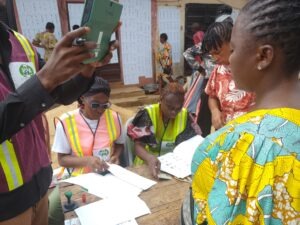
Voters casting their votes during the election in Awka
The ongoing Anambra State governorship election on Saturday received both kudos and knocks as a coalition of Civil Society Organizations (CSOs) appraised the process.
The coalition, known as the Anambra Election Observation Hub, comprises Yiaga Africa, The Kukah Centre, International Press Centre (IPC), Centre for Media and Society (CEMESO), Nigeria Women Trust Fund (NWTF), ElectHER, and TAFAfrica.
Speaking during the mid-election assessment briefing at the Radisson Hotel, Awka, the Executive Director of Yiaga Africa, Samson Itodo, said the coalition deployed 711 citizen observers across the 21 Local Government Areas (LGAs) of Anambra State.
He explained that each organization led a specific thematic pillar such as election integrity, results verification, election security, disability inclusion, gender participation, peacebuilding, misinformation tracking, and media safety.

Itodo stated that as of 7:30 a.m., INEC officials had arrived at 49% of observed polling units, which he described as an improvement from previous elections in the state, where delays in the arrival of electoral materials and personnel led to the late commencement of polls in some areas.
“Each organization leads a specific thematic pillar—such as election integrity, results verification, election security, disability inclusion, gender participation, peacebuilding, misinformation tracking, and media safety.
The Hub uses a triangulated election observation methodology combining systematic, statistical, and technology-driven tools to provide a comprehensive assessment of the election. Throughout the process, the Hub will issue two joint statements and thematic reports based on findings from each partner organization,” he said
“Anambra Central: 87% of polling units opened by 9:30 a.m.;
Anambra South: 84%;
Anambra North: 82%.
In some polling units, voting began as late as 10:31 a.m. to 12:00 noon due to delayed deployment of materials and security personnel (e.g., Nnewi North Wards 1–4 and Ihiala LGA, PU013 Ogbolo Ward).”
He added that, compared to previous elections, deployment logistics improved. Materials such as BVAS, Register of Voters, voting cubicles, and indelible ink were available
in 100% of observed polling units. However, the PWD Voter Information and Statistics Form (Form EC40H) was seen in only 86% of polling units.Itodo urged INEC to continue addressing logistical bottlenecks that delay the early commencement of polls.
“By 9:30 a.m., accreditation and voting had commenced in 85% of polling units—showing progress over past elections.
5% of polling units had more than one BVAS device.
In 3%, BVAS accreditation counts were not displayed to voters, raising transparency concerns.
Generally, BVAS functioned effectively, contributing to peaceful and orderly voting.”
On security, he said security personnel were visible and professional in most polling units, ensuring a secure voting environment. However, he noted that some polling units lacked security personnel, exposing them to potential risks of intimidation or malpractice.
On inclusivity and accessibility, 92.5% of polling units had female INEC officials presiding, while 61.8% had female security personnel on duty.
> “INEC deployed the PWD Voter Information and Statistics Form (EC40H) in several polling units, improving data documentation.
However, assistive tools such as braille ballot guides and magnifying glasses were not available, preventing blind voters from voting independently.
Some INEC officials were unaware of how to use the PWD forms, leading to inconsistent implementation.
This highlights a gap between INEC’s pre-election data and on-ground realities and shows the need for better validation of disability data and the deployment of appropriate assistive tools.”
Only one incident of media interference was reported:
A journalist from UNIZIK FM, Awka, faced mild obstruction while filming voter interviews but was allowed to continue after clarification with security personnel.
While it was still too early to determine final turnout figures, low voter turnout was recorded across several LGAs, consistent with pre-election apathy trends.
Voter turnout was estimated to be below 50% of registered polling units in operation. Despite the low turnout, voters conducted themselves peacefully, and polling officials displayed professionalism.
Itodo decried vote buying, adding that observers reported political agents using covert methods, including recording voter details for post-voting payments and using POS machines near polling units to facilitate transactions.
–